

By Andrew Henze, CFH Insurance Consultants
The Michigan Earned Sick Time Act (ESTA) Eligibility plays a pivotal role in defining the eligibility and provision of group health insurance for Michigan employees. With increasing awareness about employee rights and workplace benefits, this legislation illustrates how paid sick leave affects overall employee health policies and eligibility criteria. Under ESTA, employees gain meaningful protections ensuring they can take necessary paid sick leave without jeopardizing their group health insurance eligibility in Michigan. This article explores the implications of ESTA eligibility on group health insurance, employer health plan eligibility criteria in Michigan, detailed compliance requirements, PTO coordination, and strategic recommendations for Michigan businesses navigating evolving laws, including Michigan paid sick leave compliance 2026.
ESTA Impact on Group Health Insurance Eligibility
The Michigan Earned Sick Time Act ESTA Eligibility protects employees by defining which workers qualify for sick leave benefits. All employees working in Michigan fall under ESTA; however, employer obligations hinge on size determined by the full time equivalent employee calculation under ESTA. Specifically, employers with 50 or more FTE employees must fully comply with the act’s paid sick leave accrual and usage provisions, while smaller employers have recommended but voluntary guidelines.
Understanding these eligibility thresholds is crucial for employers to clarify obligations and for employees to understand their rights to health and benefits leave and related health insurance benefits.
Full-Time Equivalent Employee Calculation ESTA: Determining Employer Size for Eligibility
The full-time equivalent employee calculation ESTA determines employer size by converting part-time and full-time employees into a standard measure. Typically, this counts all part-time hours and divides them by the standard full-time hours (usually 40 hours/week) to derive the number of full-time equivalent employees. This calculation is essential to discerning if an employer meets the 50-employee threshold for Michigan paid sick leave compliance 2026 and thus falls under mandatory ESTA eligibility requirements.
Paid Sick Leave Accrual, Usage, and Coordination with PTO

Under ESTA, sick leave accrues at a rate of one hour per 30 hours worked, up to 40 hours annually. This fair accrual mechanism ensures equitable leave accumulation for all eligible employees. Sick leave can be used both for the employee’s own illness and caregiving for family members, embodying the act’s family-first approach to protections.
Moreover, coordination with Paid Time Off (PTO) policies is vital for employers to manage benefits seamlessly. Employers often integrate ESTA sick leave accrual with PTO policies to streamline payroll processing and ensure consistent employee benefits.
Associated Benefits, Protections, and Employer Penalty Safeguards Under ESTA Eligibility
The Michigan Earned Sick Time Act ESTA Eligibility guarantees employees several essential benefits designed to promote well-being and job security. Key benefits include:
- Systematic Accrual of Paid Sick Leave: Sick leave accrual aligns with hours worked for fairness and accessibility.
- Usage Rights for Personal and Family Care: Leave covers personal illness and family caregiving.
- Protection Against Retaliation: Employers are legally prohibited from retaliating against employees for exercising their sick leave rights.
In addition, employers benefit from clear statutory guidance minimizing risks of non-compliance penalties and litigation, promoting sound workforce management.
Implications for Employers: Compliance Actions, Penalty Protections, and Strategic Timelines for ESTA Eligibility
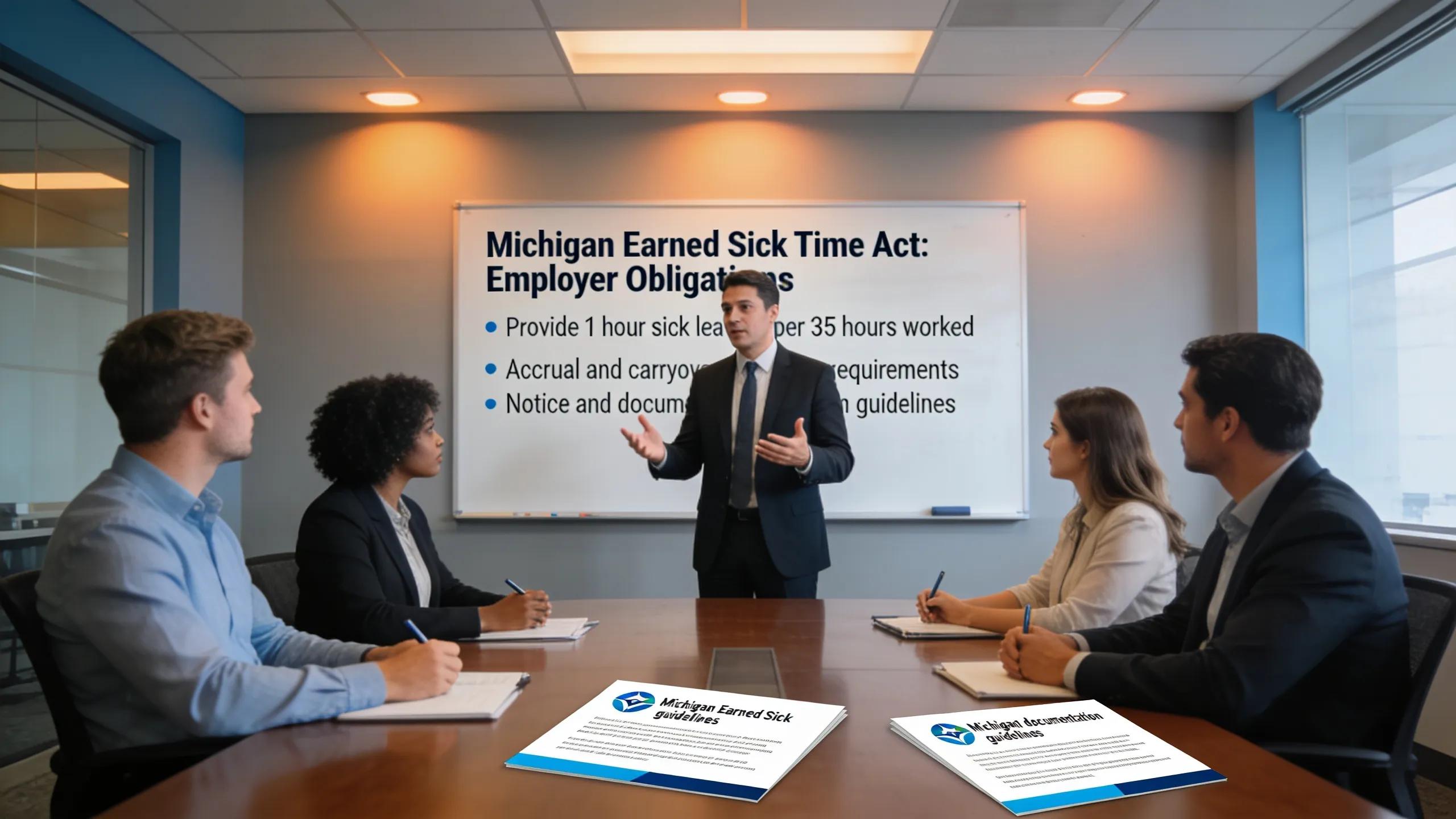
Michigan employers, especially those meeting or exceeding the 50 FTE threshold, have significant legal responsibilities under ESTA. These include adopting compliant policies, thorough record-keeping, training personnel, and aligning benefit administration with employer health plan eligibility criteria Michigan.
Key HR Action Steps to Ensure Ongoing ESTA Eligibility Compliance and Employer Penalty Protection:
- Develop Clear, Written Sick Leave and PTO Policies: Cover accrual, usage, carryover rules, and integration with health insurance eligibility.
- Conduct Regular Training Sessions: Educate HR and management on Michigan paid sick leave compliance 2026 requirements, including ACA waiting periods and ESTA rules.
- Implement Accurate and Accessible Record-Keeping: Maintain detailed hours worked, sick leave accrued and used, and employee notification records for at least three years.
- Review and Align Health Plan Eligibility: Ensure that health insurance eligibility reflects sick leave usage appropriately, with no penalties or coverage gaps.
- Fulfill Mandatory Notification Requirements: Notify employees in writing or digitally about their rights and any policy updates at hiring and annually.
- Manage Employee Requests and Complaints Effectively: Administer transparent, fair processes to handle all leave requests and disputes, preventing retaliation risks.
ESTA Compliance Timelines for Michigan Employers: Clear Deadlines and Monitoring
Employer Size Thresholds: Differentiating Small vs. Large Michigan Employers for ESTA Eligibility and Compliance
The employer’s size, determined by the full time equivalent employee calculation ESTA Eligibility, dictates the level of obligation. Below is a comparison detailing responsibilities based on employer size:
Integration of ESTA Eligibility With Group Health Insurance Enrollment, ACA Waiting Periods, and PTO Policies
While accrued sick time under ESTA Eligibility does not directly define group health insurance eligibility, it significantly impacts enrollment and coverage stability. Employers must carefully synchronize ACA waiting periods and ESTA rules with PTO and sick leave policies to avoid conflicting eligibility criteria and potential gaps in coverage.
Specifically, paid sick time accrued and used should be counted as hours worked when calculating employee full-time status under the Affordable Care Act, ensuring no unwarranted waiting periods or denial of health plan enrollment for eligible staff.
Employer Obligations for Aligning Group Health Plans With ESTA Eligibility and PTO Usage
Employers must:
- Establish and clearly communicate policies that link sick leave accrual, PTO coordination, and health insurance eligibility.
- Maintain thorough documentation proving compliance with sick leave accrual and benefits coordination.
- Coordinate benefits administration systems integrally with payroll to capture sick leave accrual and usage alongside health insurance eligibility tracking.
- Periodically review and adjust policies to align with evolving Michigan paid sick leave compliance 2026 mandates and ACA regulations.
Record-Keeping Requirements and Penalties for Non-Compliance With Michigan ESTA Eligibility
Rigorous record retention is essential for compliance verification. Employers must keep accurate, accessible records for at least three years, including hours worked, sick leave accrued and exercised, and all communications regarding employee sick leave rights.
Penalties for Non-Compliance Include:
- Fines and other civil penalties enforced by the Michigan Department of Labor and Economic Opportunity.
- Orders to reimburse affected employees for improperly denied sick leave benefits.
- Potential lawsuits, increased legal costs, and reputational harm affecting business operations.
Best Practices for ESTA Eligibility-Aligned Health Insurance and PTO Administration
To ensure compliance and promote employee satisfaction, Michigan employers should:
- Maintain transparent, accessible sick leave, PTO, and health insurance policies clearly defining their interaction and integration.
- Implement persistent training programs for HR staff and management on the latest ESTA provisions and ACA waiting periods and ESTA rules.
- Utilize integrated HR, payroll, and benefits software solutions to track leave accruals and health insurance eligibility accurately and efficiently.
- Engage legal and benefits consultants to optimize compliance strategies aligning with Michigan paid sick leave compliance 2026.
- Encourage open communication channels for employees to address questions and concerns about sick leave and health insurance benefits.
Health Reimbursement Arrangements (QSEHRA & ICHRA) Compliance Coordination With ESTA Eligibility
Employers offering Health Reimbursement Arrangements such as QSEHRA and ICHRA can harmonize these benefits with ESTA Eligibility by aligning reimbursement and eligibility policies. These arrangements can supplement sick leave by funding health expenses during leave periods, enhancing comprehensive employee support while maintaining full statutory compliance.
Frequently Asked Questions About Michigan ESTA Eligibility and Group Health Insurance Coordination
- What constitutes earned sick time under ESTA Eligibility? Sick leave accrues based on actual hours worked at a rate of 1 hour per 30 hours.
- How does ESTA Eligibility affect group health insurance plans? It necessitates coordinated plan design and eligibility management, ensuring sick leave usage complements group health insurance enrollment according to employer health plan eligibility criteria Michigan.
- What are employer obligations regarding ACA waiting periods under ESTA Eligibility? Employers must treat paid sick leave as hours worked for ACA coverage eligibility and thus avoid imposing waiting periods that conflict with ESTA rules.
- How are sick leave and PTO requests documented under ESTA Eligibility? Employers must follow clear, nondiscriminatory internal processes ensuring timely approval, record retention, and employee protections against retaliation.
How Michigan ESTA Eligibility Influences Ancillary Benefits and Overall Employee Well-Being
In addition to core health insurance, ESTA Eligibility affects ancillary benefits such as disability insurance and wellness incentive programs. Sick leave usage may affect short-term disability eligibility and participation incentives, underscoring the need for integrated benefits planning across all employee health and wellness programs.
Conclusion: Effectively Navigating Michigan Earned Sick Time Act ESTA Eligibility, PTO Coordination, and Group Health Insurance Compliance in 2026 and Beyond
Michigan employers must comprehensively understand and implement Michigan Earned Sick Time Act ESTA Eligibility compliance to effectively manage sick leave benefits and group health insurance plans. Key success factors include precise employer size assessment via full time equivalent employee calculation ESTA, maintaining meticulous records, integrating employer health plan eligibility criteria Michigan with sick leave and PTO policies, and harmonizing with ACA mandates. Strategic policy design backed by ongoing compliance monitoring will support regulatory adherence and foster a healthy, engaged workforce in 2026 and beyond.
Need Assistance Navigating Michigan ESTA Eligibility and Compliance?
For comprehensive support and expert guidance on navigating these legal complexities, Michigan businesses can contact our team. We provide tailored solutions ensuring smooth compliance and optimal health benefits administration aligned with Michigan’s earned sick time laws.