

Comparing QSEHRA vs. ICHRA for Michigan Employers
By Andrew Henze, CFH Insurance Consultants
What Are QSEHRAs and ICHRAs, and How Do They Differ?
Navigating the landscape of health reimbursement arrangements (HRAs) can be challenging for small businesses in Michigan. With options like the Qualified Small Employer Health Reimbursement Arrangement (QSEHRA) and the Individual Coverage Health Reimbursement Arrangement (ICHRA), understanding the differences is crucial for making informed decisions. This article will explore the key features, eligibility requirements, contribution limits, and tax implications of both arrangements, helping you determine which is best suited for your business needs. As small employers face rising healthcare costs, these HRAs offer flexible solutions to provide employees with health benefits while managing expenses effectively. We will delve into the specifics of each arrangement, compare their advantages and disadvantages, and provide guidance on selecting the right tax advantaged account for your Michigan business.
What Are the Eligibility Requirements for QSEHRA and ICHRA?
QSEHRA and ICHRA have distinct eligibility criteria that determine which businesses can utilize them.
QSEHRA is specifically designed for small employers with fewer than 50 employees, making it an ideal choice for small businesses. In contrast, ICHRA can be offered by employers of any size, providing greater flexibility for larger organizations. This difference in eligibility allows businesses to choose the arrangement that best fits their workforce size and structure.
How Do Contribution Limits and Flexibility Differ?
When it comes to contribution limits, QSEHRA has specific annual caps set by the IRS, which can restrict how much employers can reimburse their employees for healthcare expenses. For 2023, the maximum contribution limits for QSEHRA are $5,850 for individual coverage and $11,800 for family coverage. On the other hand, ICHRA does not impose statutory contribution caps, allowing employers to set their own reimbursement amounts based on their budget and employee needs.
Additionally, QSEHRA offers fixed reimbursement amounts, which can limit the options available to employees. In contrast, ICHRA allows employers to provide varying reimbursement amounts based on employee classes, enabling a more tailored approach to meet diverse employee needs. This flexibility can enhance employee satisfaction and retention by allowing them to choose health plans that best suit their individual circumstances.
What Are the Tax Implications for Employers and Employees?
Both QSEHRA and ICHRA offer tax advantages for employers and employees. Contributions made by employers to either arrangement are tax-deductible, providing financial relief for businesses. Additionally, reimbursements received by employees are tax-free, making these arrangements an attractive option for both parties. Understanding these tax implications can help businesses maximize their benefits while minimizing costs.
Which Arrangement Is Suitable for Your Business Size?
The suitability of QSEHRA and ICHRA varies based on business size. QSEHRA is particularly beneficial for small businesses looking to provide health benefits without the complexities of traditional group health insurance. Conversely, ICHRA is suitable for businesses of any size, offering a more customizable approach to employee health benefits. This adaptability makes ICHRA an appealing option for larger organizations with diverse employee needs.
How Do Health Reimbursement Arrangements Benefit Michigan Small Businesses?
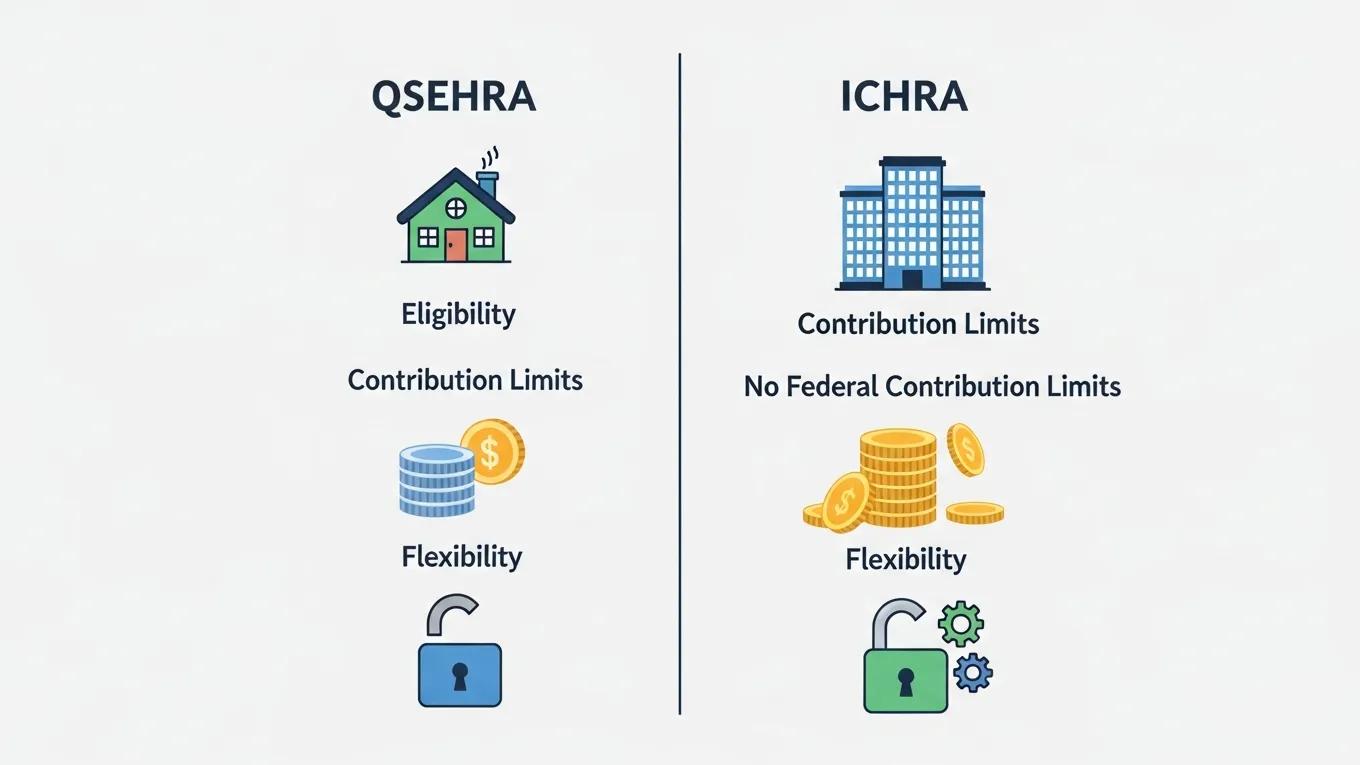
To provide a clear understanding of how QSEHRA and ICHRA serve Michigan small businesses, below is a comparative table highlighting their key features and differences:
QSEHRA vs. ICHRA: Which HRA Is Right for Your Workforce?
Making the choice between QSEHRA and ICHRA depends on multiple factors unique to your Michigan business and workforce.
1. Number of Employees
- Choose QSEHRA if you have fewer than 50 full-time employees and want a straightforward plan.
- Choose ICHRA if your business has 50 or more employees or you anticipate growth beyond 50 employees.
2. Annual Benefits Budget
- Choose QSEHRA if you prefer fixed annual contribution limits to control costs.
- Choose ICHRA if you want flexibility to set varying reimbursement amounts without statutory caps.
3. Desire for Plan Customization
- Choose QSEHRA if you want a simple, uniform plan for all employees.
- Choose ICHRA if you want to tailor benefits by employee class, such as part-time vs. full-time or geographic location.
4. Workforce Demographics
- Choose QSEHRA if your workforce has relatively homogeneous health coverage needs.
- Choose ICHRA if your workforce is diverse, with varying needs based on age, job type, or location.
According to Andrew Henze, Principal at CFH Insurance Consultants, “Choosing between a QSEHRA and an ICHRA isn’t just about company size—it’s about flexibility. While QSEHRAs are fantastic for very small teams wanting a simple, capped contribution, ICHRAs offer unparalleled customization, allowing employers to scale benefits based on employee classes like full-time, part-time, or geographic location.”
What Are the Key Compliance Rules for HRAs in Michigan?

Implementing HRAs in Michigan requires careful attention to state-specific tax laws and compliance requirements. While HRAs are governed primarily by federal regulations, Michigan adds layers of considerations that small businesses must understand to maximize benefits and avoid pitfalls.
Michigan’s Approach to HRA Regulation
Michigan generally follows federal guidelines for HRAs but also enforces state insurance laws that can impact how HRAs interact with other health coverage options. The state does not impose additional contribution limits beyond federal caps for QSEHRA but requires adherence to state insurance mandates when HRAs are paired with other health plans.
Maximizing Tax Deductions Under Michigan Law
Michigan small businesses can maximize tax deductions by properly structuring their HRAs. Employer contributions to HRAs are deductible as a business expense on Michigan state tax returns, mirroring federal treatment. Additionally, businesses should maintain thorough documentation of reimbursements and plan design to support deductions during state audits.
Michigan-Specific Filing and Reporting Requirements
While federal reporting requirements for HRAs include forms such as 1095-B or 1095-C when applicable, Michigan requires employers to ensure compliance with state health insurance mandates and may request documentation during state tax filings or audits. Employers should also be aware of Michigan’s individual mandate repeal in 2019, which affects how HRAs interact with the state’s health insurance marketplace.
Interaction with Michigan’s Health Insurance Marketplace
HRAs can affect employees’ eligibility for premium tax credits on Michigan’s health insurance marketplace. For example, QSEHRA reimbursements may reduce or eliminate an employee’s eligibility for marketplace subsidies if the HRA is considered affordable coverage. Michigan employers should educate employees on how their HRA benefits impact marketplace options and coordinate with insurance brokers or consultants to ensure compliance and optimal benefit design. For businesses seeking a broader understanding of available health coverage and alternatives, our newly optimized guide on employee health insurance vs alternative benefits offers valuable insights.
Michigan Small Business HRA Compliance Checklist
- Verify employer size eligibility: QSEHRA is strictly for employers with fewer than 50 full-time equivalent employees.
- Establish clear, written plan documents as required by ERISA and the IRS.
- Ensure employees have qualifying Minimum Essential Coverage (MEC) to receive tax-free reimbursements.
- Coordinate with a local Michigan benefits advisor like CFH Insurance Consultants to ensure compliance with IRS, ERISA, and ACA guidelines.
“Many small businesses overlook the strict compliance requirements of these accounts,” warns Henze. “For instance, failing to establish written plan documents or skipping annual non-discrimination testing can lead to costly IRS penalties. Working with an experienced local advisor ensures your plans remain fully compliant.”
Frequently Asked Questions About QSEHRAs and ICHRAs in Michigan
Can an employer offer both a QSEHRA and a traditional group health plan?
No. Employers offering a QSEHRA cannot offer a group health plan simultaneously. This restriction ensures the QSEHRA remains exclusive to qualifying small employers. However, employers offering an ICHRA can also offer group health plans to different employee classes, depending on plan design.
Are employer contributions to a QSEHRA or ICHRA subject to Michigan state payroll taxes?
Employer contributions to both QSEHRA and ICHRA are generally exempt from Michigan state payroll taxes. These contributions are treated as business expenses with tax advantages, but it’s important to consult with a tax advisor for specific situations.
What happens to unused HRA funds at the end of the plan year?
The treatment of unused funds depends on the plan design. Many HRAs allow funds to carry over year to year, but employers can set different rules. Understanding carryover provisions is key to managing employee expectations and tax compliance.
How do the 2026 HRA contribution limits affect Michigan employers?
Starting in 2026, the IRS plans to adjust certain HRA rules, potentially allowing integrated HRAs to cover more expenses. Michigan employers should stay informed about these changes through advisors like CFH Insurance Consultants to optimize their plans accordingly.
Introduction to HRAs in the Michigan Market
Health reimbursement arrangements (HRAs) have become increasingly relevant in the Michigan market as small and mid-sized businesses seek effective ways to manage healthcare costs. These arrangements allow employers to reimburse employees for qualified medical expenses, providing a valuable benefit without the burden of traditional group health insurance. Understanding the landscape of HRAs in Michigan is essential for businesses looking to enhance their employee benefits while maintaining financial control.
Detailed Breakdown of QSEHRA
QSEHRA is a specific type of HRA designed for small employers. It allows businesses to reimburse employees for individual health insurance premiums and other qualified medical expenses. This arrangement is particularly beneficial for small businesses that may struggle to provide comprehensive health insurance coverage. For businesses seeking a deeper understanding of how QSEHRA operates, our newly published qualified small employer health reimbursement arrangement guide offers detailed insights.
Eligibility Criteria for QSEHRA in Small Businesses
To qualify for QSEHRA, employers must have fewer than 50 full-time employees and cannot offer a group health plan. This makes QSEHRA an attractive option for small businesses looking to provide health benefits without the complexities of traditional insurance.
IRS Annual Contribution Limits for QSEHRA
The IRS sets specific contribution limits for QSEHRA, which for 2023 are $5,850 for individual coverage and $11,800 for family coverage. These limits are adjusted annually for inflation. Employers cannot exceed these caps when reimbursing employees for premiums and qualified medical expenses.
Reimbursement Rules and Real-World Examples
QSEHRA reimbursements must be for qualified medical expenses, including individual health insurance premiums and out-of-pocket costs. For example, a Michigan-based consulting firm with 15 employees offers a QSEHRA with a $5,000 annual reimbursement limit per employee. Employees use these funds to pay for their individual health insurance premiums purchased on the marketplace or through private insurers. This approach helps the employer control costs while providing meaningful benefits.
Pros and Cons of QSEHRA
QSEHRA offers several advantages and disadvantages for small businesses:
- Pros: Cost Control: Employers can set fixed reimbursement amounts, helping to manage healthcare costs.Tax Advantages: Contributions are tax-deductible for employers, and reimbursements are tax-free for employees.Simplicity: QSEHRA is easier to administer compared to traditional group health insurance.
- Cons: Contribution Limits: Fixed annual caps may restrict the amount of reimbursement available to employees.Limited Flexibility: Employees may have fewer options for customizing their health benefits.
Detailed Breakdown of ICHRA
ICHRA is a more flexible HRA option that allows employers to reimburse employees for individual health insurance premiums and other qualified medical expenses. This arrangement is suitable for businesses of all sizes and offers greater customization.
Flexibility of ICHRA for Employers
One of the key benefits of ICHRA is its flexibility. Employers can set varying reimbursement amounts based on employee classes, allowing for a more tailored approach to health benefits. This flexibility can enhance employee satisfaction and retention.
Employee Classes Defined by ICHRA
ICHRA allows employers to define employee classes based on various criteria, such as full-time or part-time status, geographic location, or age. The IRS permits up to 11 distinct employee classes, including:
- Full-time employees
- Part-time employees
- Seasonal employees
- Employees working in different geographic locations
- Employees in different collective bargaining units
- Employees classified by job category or role
- Employees based on their employment status (e.g., temporary vs. permanent)
- Employees grouped by age brackets
- Employees working in different divisions or subsidiaries
- Employees with different hours of service
- Employees based on their date of hire
Michigan employers can leverage these classes to tailor reimbursement amounts effectively. For example, a Michigan tech company with offices in Detroit and Grand Rapids might offer higher reimbursements to employees in higher-cost areas or differentiate benefits between full-time and part-time staff.
Pros and Cons of ICHRA
ICHRA presents several advantages and disadvantages for employers:
- Pros: Customizable Contributions: Employers can set reimbursement amounts based on employee classes, providing tailored benefits.No Contribution Caps: Unlike QSEHRA, ICHRA does not impose statutory contribution limits, allowing for greater flexibility.Tax Benefits: Contributions are tax-deductible for employers, and reimbursements are tax-free for employees.
- Cons: Complexity: Implementing ICHRA may require more administrative effort compared to QSEHRA.Employee Education: Employees may need guidance to understand how to utilize their ICHRA effectively.
Ready to Optimize Your Business’s Health Reimbursement Arrangements? Partner with CFH Insurance Consultants
Take the Next Step in Enhancing Your Employee Benefits
If you’re a Michigan small or mid-sized business looking to design, implement, or manage compliant, high-return HRAs tailored to your unique workforce, CFH Insurance Consultants is here to help. Our team specializes in customized benefits solutions that balance cost control with employee satisfaction, ensuring your health reimbursement arrangements comply with federal and Michigan-specific regulations.
Author Bio
About the Author
Andrew Henze is the Principal at CFH Insurance Consultants, a leading employee benefits advisory firm based in Michigan. With over a decade of experience helping Michigan small and mid-sized businesses design, implement, and manage cost-effective group health, life, dental, vision, and wellness benefits, Andrew is a trusted authority on local market trends and regulatory compliance.