By CFH Insurance Consultants, CFH Insurance Consultants
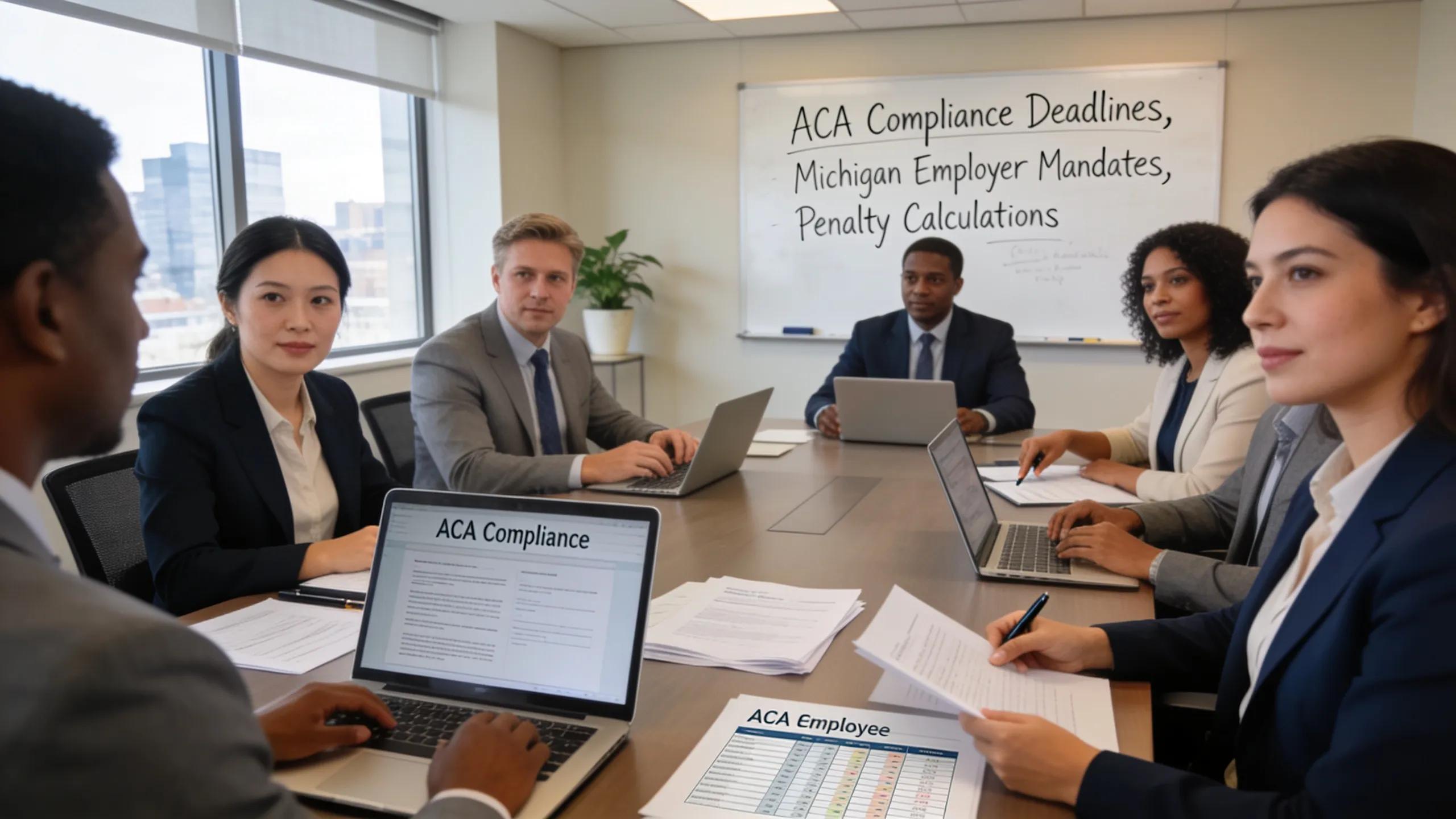
With the Affordable Care Act (ACA) regulations continually evolving, mastering ACA Employer Penalties Compliance Strategies has become imperative for Michigan businesses. This comprehensive guide deepens your knowledge of compliance mandates, penalty structures, and strategic frameworks aimed at mitigating risks under the ACA employer shared responsibility provisions in 2026. Understanding these nuances is vital as Michigan businesses navigate both federal mandates and state-specific health care laws.
In this article, you will find detailed discussions on Applicable Large Employer (ALE) thresholds, the 2026 Employer Shared Responsibility Payment (ESRP) penalty calculation formulas, affordability safe harbors, IRS Letter 226J protocols, audit prevention strategies, and key deadlines integral to maintaining compliance. The incorporation of relevant secondary keywords such as “ALE determination”, “penalty avoidance frameworks”, “ACA affordability standards”, and employer reporting requirements enrich this guide for enhanced visibility and utility.
Understanding The ACA Employer Mandate and ALE Thresholds in Michigan
The ACA Employer Mandate requires that Applicable Large Employers (ALEs) provide Minimum Essential Coverage (MEC) to qualifying employees. An ALE is determined based on a workforce size averaging 50 or more full-time equivalent (FTE) employees during the prior calendar year. This calculation includes full-time employees (working 30 or more hours per week) and aggregates part-time employees into FTE metrics, which requires diligent record-keeping to accurately establish employer status.
Correct ALE determination directly impacts your ACA obligations, including potential penalties. Michigan employers must be particularly mindful of this threshold as it represents the pivotal compliance benchmark triggering reporting and coverage offerings under federal law.
Defining ALE Thresholds
- Full-Time Employee: An employee working on average 30+ hours weekly.
- Full-Time Equivalent (FTE): Aggregate part-time hours divided by 120 to compute equivalent full-time positions.
- ALE Determination: Total full-time employees plus FTEs across all controlled group employers exceeds or equals 50 in a calendar year.
Navigating ACA Employer Penalties: A Compliance Guide for Michigan
For ALEs in Michigan, failure to comply with the ACA employer mandate exposes the business to the Employer Shared Responsibility Payment (ESRP) assessed under IRS Sections 4980H(a) and 4980H(b). Understanding the calculation methods for these penalties is critical for effective risk management.
4980H(a) Penalty Formula (No Coverage Offered)
This penalty applies if an ALE fails to offer MEC to at least 95% of full-time employees (and their dependents). The penalty for 2026 is calculated as:
4980H(b) Penalty Formula (Coverage Offered but Unaffordable or Lacking Minimum Value)
This penalty is assessed when coverage is offered but either unaffordable or lacking minimum value, and at least one full-time employee receives a premium tax credit. The calculation is:
Both penalties are assessed monthly based on the number of months of non-compliance within the calendar year. Employers should stay current with IRS indexing adjustments to these penalty amounts.
Comprehensive Affordability Safe Harbors to Mitigate Penalties
To ensure coverage affordability and avoid 4980H(b) penalties, Michigan employers can leverage IRS-established safe harbors that simplify affordability determinations. These safe harbors help demonstrate that employee contributions do not exceed the affordability threshold defined relative to household income.
Main Affordability Safe Harbors
- Federal Poverty Line (FPL) Safe Harbor: Premium contributions do not exceed 9.12% (2026 rate) of the Federal Poverty Line for a single individual.
- Rate of Pay Safe Harbor: Based on an employee’s hourly wage multiplied by 130 hours (approximate full-time hours per month).
- W-2 Wage Safe Harbor: Uses the amount reported in Box 1 of the employee’s W-2 wage statement.
Implementing these safe harbors effectively enables employers to quantify affordability with quantifiable metrics recognized by the IRS, reducing the risk of penalty assessments.
IRS Letter 226J: Responding to Employer Notice of Potential Penalties
The IRS issues Letter 226J after matching employer-reported Form 1094-C/1095-C data with employee premium tax credit claims, notifying ALEs of potential ESRP penalties. Swift and methodical responses are essential to dispute inaccuracies or provide evidence of compliance.
Recommended response framework for Michigan ALEs:
- Thoroughly review the letter for accuracy of employee counts, offer data, and affordability.
- Compile detailed documentation: Payroll records, offer letters, enrollment databases, safe harbor calculations.
- Engage benefits and legal professionals to prepare comprehensive responses or appeals.
- Submit response within IRS deadlines typically 30 days to avoid default penalty assessments.
Audit Prevention and ACA Employer Penalties Compliance Strategies
Proactive audit prevention not only minimizes penalty risks but ensures sustained compliance excellence. Effective practices for Michigan businesses include:
- Maintain meticulous documentation of employee hours, offer records, and benefits communications.
- Conduct internal ACA compliance audits semi-annually to validate MEC offerings, affordability, and accurate reporting.
- Implement automated tracking systems for employee eligibility and coverage status.
- Regularly train HR and benefits staff on ACA updates and reporting requirements.
- Use affordability safe harbors consistently and track calculations for audit trails.
- Ensure timely and error-free Form 1094-C/1095-C filings meeting IRS deadlines with verification checks.
Essential Michigan Business ACA Compliance Strategies for 2026
Michigan employers can strengthen their ACA compliance and reduce exposure to penalties by implementing these targeted strategies:
- Establish an ACA compliance team with roles focusing on data collection, reporting, and employee communication.
- Leverage technology such as ACA compliance software to automate calculations and reporting.
- Periodically review and update health plan designs to meet MEC and minimum value criteria.
- Utilize affordability safe harbors consistently and document rationale.
- Educate employees proactively about their coverage options and enrollment responsibilities.
- Integrate Michigan state health law guidance into compliance strategies to ensure adherence to regional specifics.
Key ACA Employer Reporting Requirements and Critical Michigan Deadlines
ALEs must comply with IRS reporting obligations by submitting Forms 1094-C and 1095-C annually. Precision and timeliness are paramount to avoiding additional penalties related to inaccurate or late filings.
- January 31, 2026: Distribute Form 1095-C statements to all full-time employees outlining coverage specifics.
- February 28, 2026 (Paper) / March 31, 2026 (Electronic): Submit Form 1094-C transmittals and 1095-C forms to the IRS.
Employers should prepare early to ensure thorough data accuracy and comply with these deadlines.
Leveraging QSEHRA and ICHRA for ACA Compliance in Michigan
Qualified Small Employer Health Reimbursement Arrangements (QSEHRA) and Individual Coverage Health Reimbursement Arrangements (ICHRA) provide valuable flexibility for Michigan small businesses to support ACA compliance. They enable employers to reimburse employees for individual health insurance premiums in a controlled, tax-favored manner that meets MEC criteria.
Benefits of QSEHRA and ICHRA include:
- Providing affordable coverage alternatives aligned with ACA requirements.
- Offering cost predictability and budgeting advantages for employers.
- Facilitating compliance reporting under Forms 1094-C and 1095-C.
Incorporating these arrangements alongside traditional group health insurance costs plans or independently can optimize benefits and penalty avoidance.
Summary: Elevating Michigan Business ACA Employer Penalties Compliance Strategies
Michigan businesses must prioritize comprehensive compliance with the ACA employer mandate to safeguard against severe financial penalties in 2026 and beyond. This involves:
- Accurately determining ALE status using full-time and FTE counts.
- Understanding and applying the 2026 ESRP penalty calculation formulas for Sections 4980H(a) and (b).
- Using affordability safe harbors to prove coverage affordability and minimize penalty risks.
- Developing robust audit prevention practices including meticulous documentation and timely IRS reporting.
- Responding effectively to IRS Letter 226J notices when received.
- Utilizing resources such as SHIP, SBDCs, and specialized consultants for support.
Adhering to these elevated compliance strategies ensures Michigan employers can confidently navigate the ACA landscape, optimize employee health benefits, and avoid costly employer penalties.
For additional guidance and expert advice on ACA employer penalties and compliance strategies, contact CFH Insurance Consultants to build a resilient ACA compliance framework tailored to your business needs.
Frequently Asked Questions
How does an ICHRA differ from a traditional group plan?
With an individual coverage HRA, the employer sets an allowance and employees buy their own individual coverage, which the employer reimburses tax-free. The employer gets a defined, predictable cost rather than a renewal that moves each year. The trade-offs are that employees shop for their own plan, and the arrangement has to be structured by employee class with proper notice, or it fails its own rules.
Can we offer a QSEHRA alongside a group health plan?
No. A QSEHRA is only available to employers that do not offer a group health plan to any employee. Employers who want to combine an allowance with group coverage are usually looking at an individual coverage HRA or a different arrangement instead, and the choice has consequences for employees’ eligibility for marketplace subsidies.
How is affordability actually measured?
Affordability is tested against the employee-only cost of your lowest-cost plan that meets minimum value, not the family cost. That catches employers out: a plan that looks generous overall can still fail the test if the employee-only contribution is set too high. The IRS publishes safe harbors based on W-2 wages, rate of pay or the federal poverty line, and most employers use rate of pay for its predictability.